

The first few books of the Bible are incredibly interesting. After Genesis and the establishment of the first people and their stories, we have the introduction of a nation. Then, the Exodus from Egypt occurred in 1445 BC, and the tabernacle was finished a year later. Leviticus picks up at this point in time. Israel now has a place to worship (tabernacle) while camped at Mount Sinai. This gives purpose to the establishment of a formal priesthood and offerings. Why? The Israelites have a messed up view of worshipping God, skewed by the plethora of Egyptian gods and worship practices witnessed while enslaved.
God creates the Levitical laws not to restrict His people, add another item on to-do lists, create an seemingly improbable standard of living, or any of the like. His reason was to give a misguided people direction. The purpose of God’s laws was to set apart His people from the pagan gods, and the immoral actions of their practitioners around them. This includes Egypt, where they came, and Canaan, where they were going.
As a parent, why do you give rules to your kids? Is it because you want to just give them rules to make their lives more difficult? No, there is a reason. You’re setting a standard, or expectation for your house and family. Oftentimes your rules are contrary to the outside world, or how other people do things. This was God’s intentions as well. God’s laws- sacrifices, criminal codes, cooking, clothing, diet, sexual practices, dealing with sickness- were instituted by God to set His people apart from the pagans and others.
Check out the below visual chart that shows the Offerings:
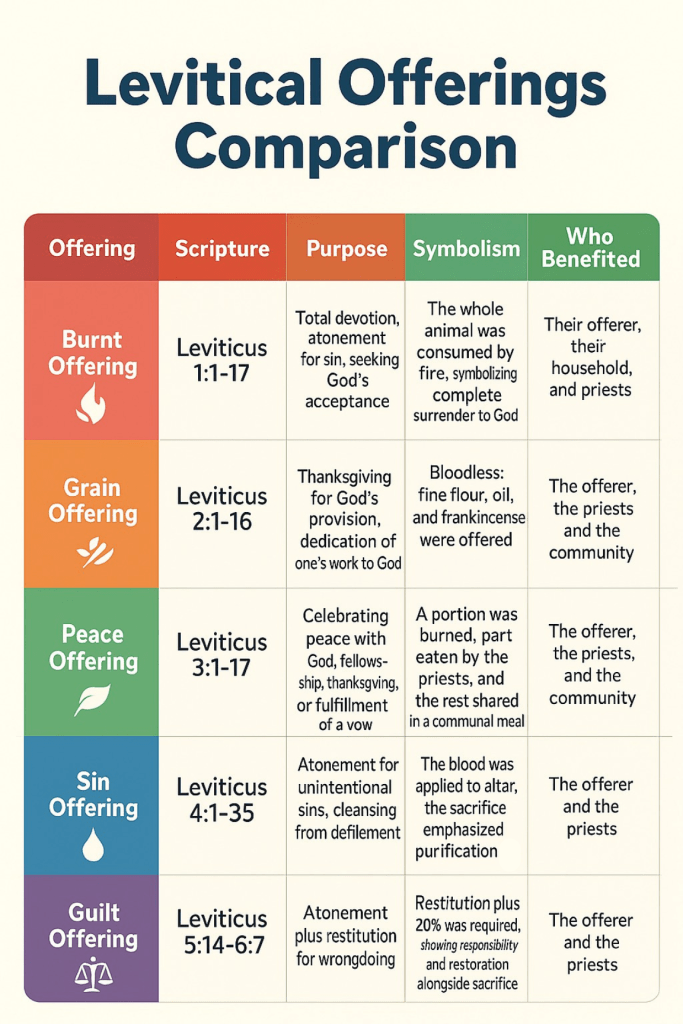
Why do these matter to us today? Christ fulfills all (5) offerings for us as Christians, today!
While we no longer bring animals, grain, or restitution offerings, the five offerings point directly to Christ and to how we live out our faith. Here’s the correlation:
1. Burnt Offering- Total Surrender to God
- Then: The entire animal was consumed, symbolizing complete devotion.
- Now: Christ gave Himself fully for us (Ephesians 5:2). We respond by offering our whole lives to God.
- Romans 12:1 — “Offer your bodies as a living sacrifice, holy and pleasing to God—this is your true and proper worship.”
2. Grain Offering- Thanksgiving and Service
- Then: Bloodless offering of flour, oil, and incense — expressing gratitude for God’s provision.
- Now: Christ is the “bread of life” (John 6:35). We show gratitude by dedicating our work, gifts, and daily life to Him.
- Colossians 3:17 — “Whatever you do, in word or deed, do everything in the name of the Lord Jesus, giving thanks to God.”
3. Peace Offering- Fellowship with God and Others
- Then: Shared meal between God, priests, and worshipers — celebrating peace.
- Now: Through Christ, we have peace with God (Romans 5:1). Communion (the Lord’s Supper) reflects this — we share in His body and blood together.
- 1 Corinthians 10:16 — “The cup of blessing… is it not a participation in the blood of Christ? The bread… a participation in the body of Christ?”
4. Sin Offering- Forgiveness and Cleansing
- Then: Blood shed to purify from unintentional sin.
- Now: Jesus became our sin offering once for all (2 Corinthians 5:21). His blood cleanses us from all sin.
- Hebrews 9:13–14 — “How much more will the blood of Christ… cleanse our consciences from acts that lead to death, so that we may serve the living God!”
5. Guilt Offering- Restitution and Restoration
- Then: Required repayment + 20% to make things right.
- Now: Jesus paid the full debt of our sin (Colossians 2:13–14). As His followers, we practice reconciliation — making things right with others when possible.
- Matthew 5:23–24 — “First be reconciled to your brother, then come and offer your gift.”
So, next time someone wants to de-rail this section of the Old Testament, or look to say that the reasoning behind the Levitical Law holds little value, you now understand the reasoning. God created the Law to set his people apart and now Christ is the fulfillment of that Law.
 goapologetics
Leave a comment